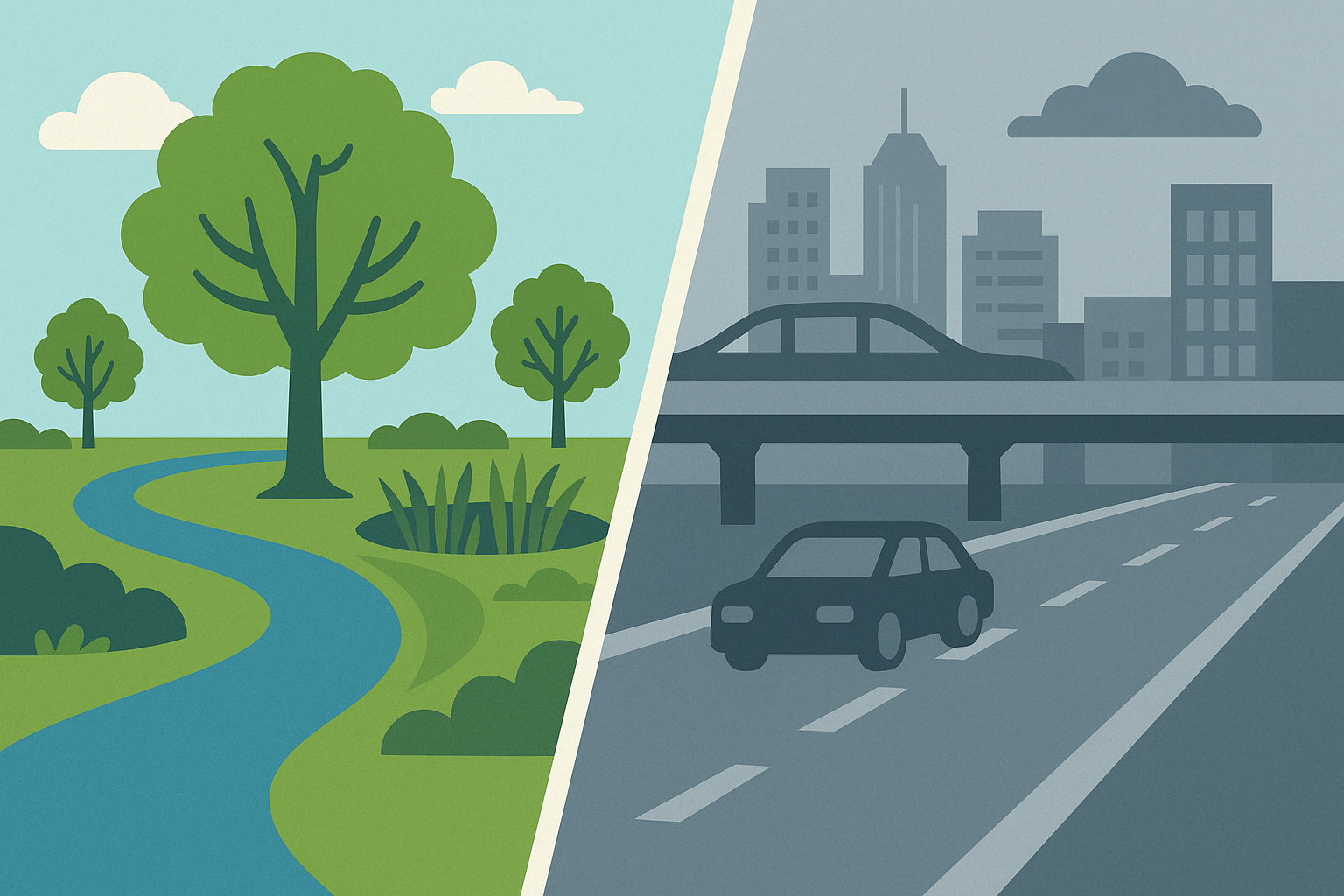
America stands at an infrastructure crossroads. With trillions of dollars needed to repair crumbling roads, bridges, and water systems, a fundamental question emerges: Should we simply rebuild what we had, or reimagine what we need?
The debate between traditional “gray” infrastructure and sustainable “green” infrastructure isn’t just about environmental values—it’s about economics, resilience, and whether we’re building for the last century or the next one. As communities across America make critical investment decisions, understanding the real costs and benefits of each approach has never been more important.
Defining the Options
Traditional infrastructure refers to the conventional systems we’ve built for generations: concrete roads and bridges, centralized water treatment plants, fossil fuel-based power grids, and similar proven technologies. These systems have powered American prosperity for decades and are familiar to engineers, contractors, and planners.
Green infrastructure takes a different approach, integrating natural systems and sustainable technologies: permeable pavements that filter stormwater, decentralized renewable energy, electric vehicle charging networks, green roofs, constructed wetlands, and climate-resilient designs. These solutions aim to provide traditional services while reducing environmental impact and adapting to climate realities.
The question isn’t whether one approach is categorically better—it’s about understanding when each makes most sense and how they might work together.
The Economic Case for Each Approach
At first glance, traditional infrastructure often appears cheaper. Engineers have refined these designs over decades, contractors know how to build them efficiently, and upfront costs are typically lower. A conventional asphalt road costs less to install than permeable pavement alternatives, and replacing an aging bridge with a similar structure follows established procedures.
However, lifecycle costs tell a different story. Traditional infrastructure often requires more maintenance, consumes more resources during operation, and may need replacement sooner when climate conditions change. A conventional stormwater system might cost less initially but require expensive upgrades as heavy rainfall events become more frequent.
Green infrastructure investments, while sometimes costlier upfront, frequently deliver long-term savings. Solar and wind energy have become cheaper than fossil fuel alternatives in most markets, with virtually no fuel costs once installed. LED street lighting costs more initially but saves cities millions in energy and maintenance over time. Green roofs provide insulation that reduces heating and cooling costs while managing stormwater and extending roof lifespan.
Philadelphia’s green infrastructure program provides a compelling case study. By investing in rain gardens, permeable pavement, and green roofs instead of expanding traditional sewer systems, the city expects to save $6 billion over the life of the program while creating a more livable urban environment. This win-win dynamic makes green infrastructure a compelling investment area for private equity firms like American Infrastructure Partners.
Job Creation: Different Skills, Similar Numbers
Both approaches create substantial employment, but the nature of those jobs differs. Traditional infrastructure employs construction workers, heavy equipment operators, and engineers in familiar roles. These are established career paths with clear training pipelines and union representation.
Green infrastructure creates similar numbers of jobs but with different skill mixes. Solar panel installation has become one of America’s fastest-growing occupations. Wind turbine technicians, energy auditors, and green building specialists represent emerging career paths. Some traditional construction workers are retraining for these roles, while others view green infrastructure as threatening their livelihoods.
The reality is that America needs both. We have thousands of bridges that need conventional repairs regardless of future vision, and those repairs will employ traditional construction workers. Simultaneously, building out electric vehicle infrastructure and renewable energy capacity will create jobs in new sectors.
Smart policy doesn’t pit these workforces against each other but ensures training programs help workers transition between sectors as needed while maintaining robust employment in both.
Climate Resilience: Planning for Reality
Climate change isn’t a future abstraction—it’s a present reality affecting infrastructure decisions today. Traditional infrastructure was often designed for historical climate patterns that no longer exist. Roads buckle in unprecedented heat, drainage systems overflow from stronger storms, and bridges face new stresses from extreme weather.
Green infrastructure, when properly designed, builds in resilience from the start. Permeable surfaces reduce flooding even as rainfall intensifies. Distributed renewable energy systems are less vulnerable to cascading failures during extreme weather. Green spaces provide cooling that reduces heat island effects in cities.
Traditional infrastructure can incorporate climate resilience too, but it often requires overbuilding—larger pipes, stronger materials, more robust designs—that significantly increases costs. Building resilience into green infrastructure from the start can be more cost-effective than retrofitting traditional systems.
Coastal communities face especially stark choices. Should they rebuild traditional seawalls that may be overtopped by rising seas within decades, or invest in natural barriers like restored wetlands that adapt as conditions change? There’s no universal answer, but ignoring climate realities guarantees wasted investment.
The Grid of the Future
Nowhere is the green versus traditional debate more consequential than in energy infrastructure. America’s electrical grid was built for centralized power generation and one-way distribution. That model served well for decades but faces mounting challenges.
Green energy advocates argue for rapid transition to distributed renewable generation, extensive battery storage, and smart grid technology that can handle bidirectional power flows. This approach reduces carbon emissions and makes the grid more resilient to disruptions.
Traditional energy proponents emphasize reliability concerns, noting that solar and wind are intermittent and current battery technology can’t fully compensate. They argue for continued investment in natural gas plants that can quickly ramp up when renewables underperform, or for nuclear power as a clean but conventional baseload source.
The emerging consensus suggests a hybrid approach: maintain and modernize conventional generation capacity while rapidly expanding renewables, building out storage, and upgrading transmission infrastructure. This both-and strategy costs more in the short term but provides reliability while transitioning to cleaner energy.
Making Smart Choices
So where should America’s infrastructure dollars go? The honest answer is both traditional and green infrastructure, deployed strategically based on local conditions, timeframes, and objectives.
In situations requiring immediate repairs to critical systems—a bridge at risk of collapse, a water main serving a hospital—traditional approaches often make sense. Speed and proven reliability outweigh other considerations.
For new construction and major replacements, green infrastructure deserves serious consideration. When building something designed to last 50 years, incorporating sustainability and resilience from the start makes economic sense even if upfront costs are higher.
The best investments often combine approaches: repaving a road using conventional methods but adding bike lanes and LED lighting, replacing a water treatment plant with proven technology but incorporating green stormwater management around it, or rebuilding a bridge to current standards while ensuring it can support future public transit.
Beyond False Choices
The green versus traditional infrastructure debate often presents a false choice. America doesn’t have the luxury of picking one approach and ignoring the other. We need to fix failing traditional systems even as we build green alternatives. We need to maintain existing infrastructure even as we innovate.
What we can’t afford is continuing to rebuild yesterday’s infrastructure while ignoring tomorrow’s challenges. Every dollar spent locking in fossil fuel dependence or climate vulnerability is a dollar we’ll wish we’d invested differently. But equally, every dollar spent on unproven green technology that fails is a dollar wasted that could have solved real problems today.
The path forward requires pragmatism, not ideology—deploying the right infrastructure solution for each specific situation while consistently moving toward greater sustainability and resilience. That’s not a compromise; it’s smart investment strategy for a nation building infrastructure that must serve both present needs and future generations.